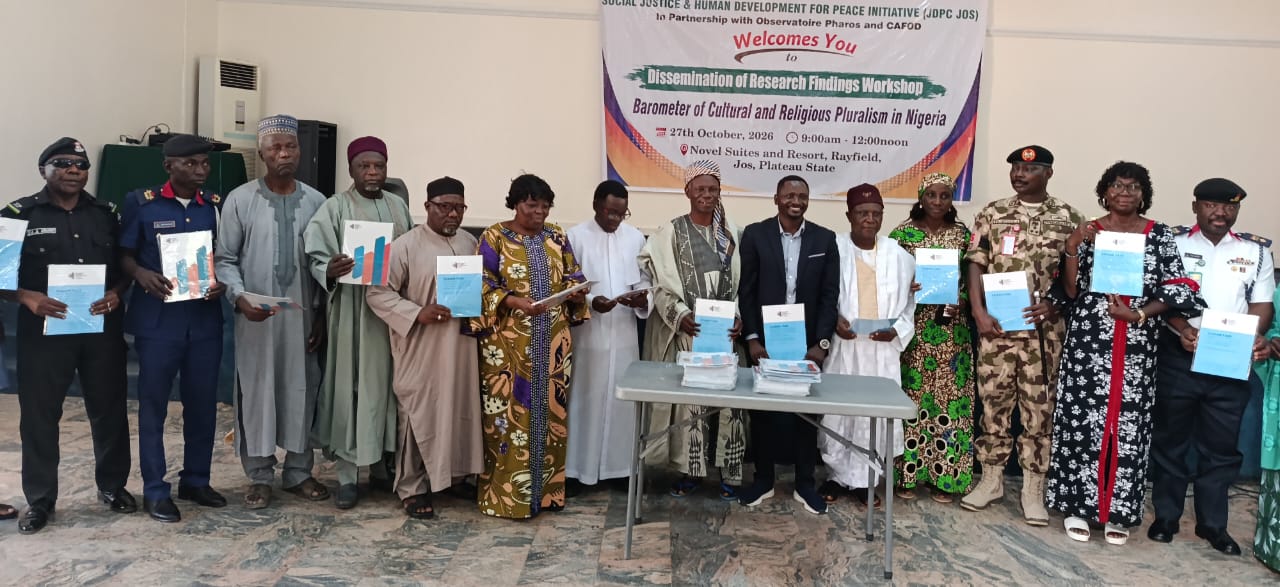

A peacebuilding study covering communities in Plateau and Kaduna states has recommended legal reforms to address the indigene-settler classification system, including the recognition of long-term residency as a basis for civic rights.
The recommendation was among the proposals presented by the Social Justice and Human Development for Peace Initiative (JDPC) of the Catholic Archdiocese of Jos during the unveiling of its research findings under the project, “Barometer of Cultural and Religious Pluralism in Nigeria”.
The study covered Barkin Ladi and Bokkos local government areas of Plateau State, as well as Kaura and Jema’a local government areas of Kaduna State.
Presenting the findings, the Lead Researcher, Mwansat Samuel, identified rumours, misinformation, hate speech, identity-based claims and historical grievances among the factors contributing to conflict in the communities.
Samuel, a lecturer in the Department of Mass Communication at the University of Jos, also cited declining communication among community leaders, social segregation, drug abuse and exclusion as issues undermining peaceful coexistence.#
As part of the recommendations, Samuel called on the National Assembly to clearly distinguish between indigene and settler status in the Constitution.
He also urged state Houses of Assembly to enact legislation recognising long-term residency as the legal basis for civic rights, effectively replacing the indigene-settler classification system.
The proposals seek to address questions surrounding belonging, residency and civic rights in communities where identity and historical grievances can complicate relationships among residents.
However, the research findings presented did not include detailed evidence on how the proposed reforms would be implemented or their anticipated effects in the four study areas.
The researchers also called on the Federal Government to provide dedicated protection for shared economic infrastructure, including mining sites, grazing corridors, irrigation schemes and transport hubs.
The recommendation highlights the importance of protecting facilities and resources used by different groups, although the findings presented did not specify particular incidents involving the listed infrastructure.
Samuel further urged religious councils and faith leaders to collaborate with regulatory bodies and civil society organisations to establish clear guidelines against hate speech and inflammatory preaching.
He said the efforts should be accompanied by initiatives promoting tolerance and interfaith dialogue.
The researcher added that civil society organisations, security agencies, traditional institutions and local government authorities had important roles to play in achieving lasting peace.
Earlier, the Assistant Coordinator of JDPC, Rev. Fr. Basil Kassam, said the research was designed to support engagement with communities, particularly on early warning and early response to conflict.
He said the findings could assist policymakers, civil society organisations and local and international partners in developing more comprehensive approaches to peacebuilding.
Kassam described the research as a pilot scheme that had produced practical recommendations for strengthening peaceful coexistence.
The project was supported by the Catholic Agency for Overseas Development (CAFOD) and funded by Observatoire Pharos, a French organisation.
Kassam also called on religious and community leaders, youth groups and women’s groups to work together towards achieving lasting peace.