

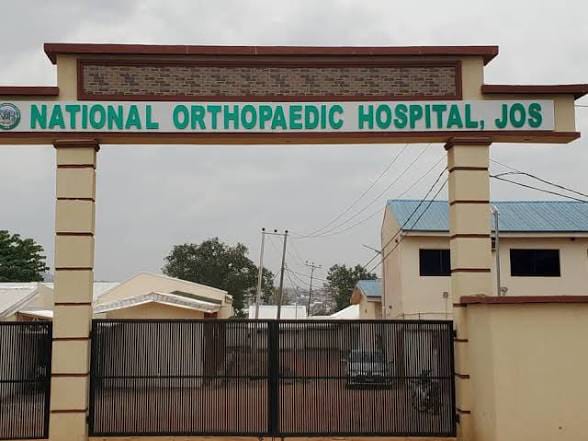
The National Orthopaedic Hospital, Jos, has released its account of the medical treatment given to Bilat Raphael, a nursing student who was brought to its Accident and Emergency Unit after collapsing during a football match, alleging that some of the students who accompanied him interfered with efforts to resuscitate him.
The hospital said Raphael, a student of the College of Nursing Sciences, Anaesthesia Programme, at the Jos University Teaching Hospital (JUTH), arrived at its facility at about 6:05 p.m. on Monday, November 16, in an unresponsive condition.
In a statement issued on Thursday, November 19, the hospital management said it was responding to reports about the circumstances surrounding the student’s treatment and provided a timeline of events based on the records of medical personnel on duty.
According to the statement, the student was brought to the hospital following a reported sudden collapse on a football pitch. Medical personnel who assessed him reportedly found him pale, cold to the touch and clinically unresponsive, with fixed and dilated pupils and a Glasgow Coma Scale (GCS) score of 3/15.
The hospital said the doctor on call was immediately notified, while nurses commenced resuscitation procedures and established an intravenous line.
It also disclosed that a random blood sugar test conducted on the patient returned a reading of 8.4 mmol/L.
“The doctor on call confirmed clinical unresponsiveness secondary to cardiac arrest. While cardiopulmonary resuscitation (CPR) continued, normal saline infusion and 200 mg of IV Hydrocortisone were administered,” the statement said.
The management added that cardiac monitoring showed a body temperature of 31 degrees Celsius, while the patient’s pulse, blood pressure and oxygen saturation could not be recorded.
It said intravenous adrenaline was administered and supplemental oxygen provided, but the patient remained unresponsive.
Hospital alleges interference by student nurses
The hospital attributed part of the difficulties encountered during the resuscitation to what it described as the overwhelming presence and actions of some student nurses who accompanied Raphael.
It alleged that the crowd overwhelmed the A&E Unit, internal security personnel and operatives of the Nigeria Security and Civil Defence Corps (NSCDC) deployed at the facility.
The statement said: “Despite repeated appeals, the agitated crowd obstructed hospital specialists from taking full control of the patient’s management, insisting on performing endotracheal intubation themselves and administering unapproved doses of IV Adrenaline (up to six ampoules) and Atropine, against the explicit medical advice of the attending physician.”
The hospital said the students subsequently requested that Raphael be transferred to JUTH after prolonged resuscitation efforts.
It stated that his temperature had dropped to 30 degrees Celsius, while his oxygen saturation was 42 per cent, with pulse and blood pressure still unrecordable.
According to the management, a second doctor on call reassessed the patient and counselled the students on his critical prognosis before granting formal consent for the transfer.
The hospital said its ambulance was deployed at 8:59 p.m. and departed at 9:05 p.m., accompanied by the nurse on duty, a hospital porter and student representatives.
“Resuscitation continued throughout transit (GCS 3/15, SpO₂ 42%), until the patient was formally handed over to the A&E team at JUTH at 9:20 PM,” the statement added.
The ambulance reportedly returned to the hospital at 10:05 p.m.
Second student stabilised
The hospital also disclosed that another student from the same group was brought to its emergency unit in critical condition during the incident.
It said its medical team attended to her and successfully stabilised her until she regained consciousness.
“Our medical team promptly attended to her, successfully stabilizing her until she fully regained consciousness,” the management stated.
Meanwhile, a report by Western Post quoted a colleague of Raphael, identified as Ifeoma Onyibe, as alleging that the students experienced delays in receiving medical attention and that basic emergency facilities were not readily available.
“We spent two hours in FOH before taking him to JUTH and until we left, the doctor on call was nowhere to be found. They don’t make provisions for basic things such as emergency resuscitation kits in their A&E,” Onyibe was quoted as saying.
The allegation contrasts with the hospital’s account that the doctor on call was immediately notified and emergency interventions commenced upon the student’s arrival.
The National Orthopaedic Hospital, Jos, maintained that it deployed life-saving medications, intravenous fluids and emergency drugs as necessary, while urging the public to disregard what it described as unverified narratives.
The management also appealed for calm, stressing that obstructing medical specialists and forcefully administering restricted emergency drugs could compromise standard clinical care.
It reaffirmed its commitment to saving lives, upholding medical ethics and serving the public professionally.







They are trying to defend themselves as if they have not been delaying the treatment of patients carelessly.