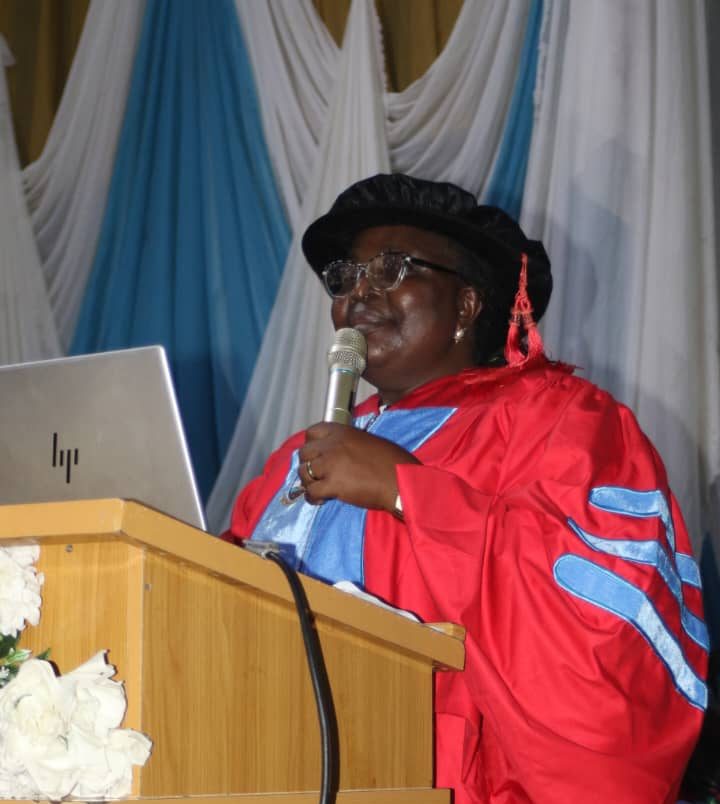
A Professor of Phonetics and Phonology at the University of Jos, Prof. Modupe Olubunmi Onwochei, has urged Nigerians to stop treating the influence of indigenous languages on English as errors or bad English, describing it instead as language transfer.
Onwochei made the call on Tuesday while delivering the 131st inaugural lecture of the University of Jos, titled, “When Your L1 ‘Speaks’ in Your L2: Mother Tongue Interference and the Limits of Mutual Intelligibility in Nigerian English.”
She said the influence of a speaker’s first language, or L1, on English, which is often the second language or L2, was a natural consequence of Nigeria’s multilingual environment.
“For too long, we have called these interference. We have called it bad English. We have also called it errors and mistakes. Let us call it by the proper name: transfer. We would rather call it transfer than mistakes and errors.
“Let us describe it. Let us study it. Let us not see it as a problem to be erased, but as something to be understood and managed,” she said.
The don said Nigerian English had been “reshaped, rearranged and reorganised” by the country’s indigenous languages, adding that Nigerians were developing their own norms of English usage.
According to her, the lecture examined the influence of Hausa, Igbo, Yoruba, Berom, Jukun and Fulfulde on Nigerian English, particularly the way differences in their sound systems affect the pronunciation of English.
She said the influence of indigenous languages was not limited to pronunciation but could also be seen in grammar, vocabulary and pragmatics, including culturally influenced expressions of politeness and respect.
Onwochei said the important issue was not whether Nigerians spoke English differently from native English speakers, but whether such differences eventually affected mutual understanding.
“Now we come to the crux of the matter. All the things that I have said: When does it become a problem? When does it challenge understanding? When does it limit our ability to express ourselves correctly?” she said.
She explained that mutual intelligibility referred to the ability of one speaker to understand another without requiring special training.
The professor said some forms of language transfer posed little difficulty to communication, while others could create misunderstanding when differences in pronunciation or stress changed the way words were perceived.
She also cited findings from her previous research involving 100 respondents, comprising 50 Nigerians and 50 native English speakers.
She said the study, which involved about five tests examining speech production and perception, found that Nigerian speakers were more intelligible to British participants in many instances, while Nigerian participants understood the British speakers at about 54 per cent.
“The update on the finding was shocking. We realised, or we discovered, that the Nigerian speakers were more intelligible to the British in many instances, while our L1 speakers understood the British people at 54-something per cent,” Onwochei said.
She called for a balanced approach to English-language teaching in Nigeria, urging educators to teach standard English while recognising the country’s linguistic diversity.
“We must teach the standard. There are two standards as we are here. We have Standard British English, isn’t it, and Nigerian English. Let us know it. Let us understand it. Let us know when and where to use it”
The don also called for curriculum development and research materials that would give greater attention to Nigerian English and the country’s multilingual environment.
Earlier, the Vice-Chancellor of the University of Jos, Prof. Tanko Ishaya, described the inaugural lecture as an important academic tradition through which professors share their research and scholarship with the wider university community.
He noted the relevance of the lecture’s subject to Nigeria’s linguistic environment, particularly the influence of mother tongues on the way Nigerians communicate in English.
Ishaya expressed the hope that the lecture would contribute to ongoing discussions on language development and policy in Nigeria.