
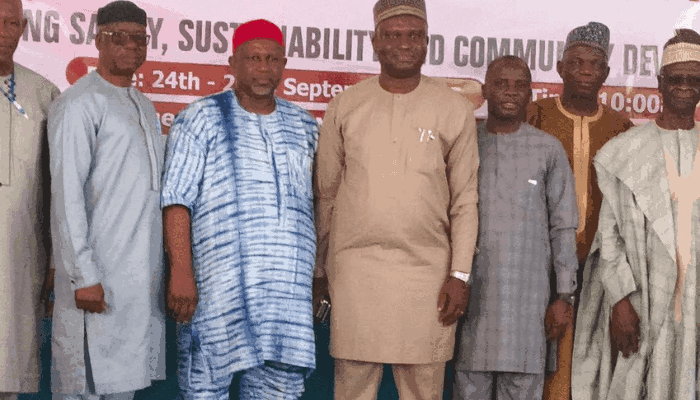
The University of Jos, in partnership with the Petroleum Technology Development Fund (PTDF), has taken a significant step toward transforming mining activities in Plateau State by equipping artisanal and small-scale miners with practical knowledge on safety, sustainability, and community development.
Held on the 24th and 25th of September 2025, the two-day capacity-building workshop brought together stakeholders from mining communities, academia, government, and industry at the university’s Faculty of Management Sciences.
With the theme “Enhancing Safety, Sustainability, and Community Development in Mining,” the programme sought to address long-standing challenges in the sector—particularly those affecting local miners who often work under unsafe and poorly regulated conditions.
Speaking at the opening session, the Vice Chancellor of the University, Prof. Tanko Ishaya represented by Prof. Samuel Odey, said the workshop reflects the university’s continued effort to connect academic research with grassroots realities.
“The University of Jos is honored to host this important workshop on sustainable and responsible mining for community empowerment. This initiative strongly aligns with our commitment to knowledge-driven solutions that improve lives and protect our environment,” he said.
Prof. Ishaya further emphasized that the Middle Belt region is not only rich in mineral deposits but also in human potential. He called for education and research to play a leading role in promoting inclusive growth and safer mining practices across communities.
For the Chairman of the UNIJOS PTDF Professorial Chair in Geology and Mineral Science, Prof. Nuhu Samaila, the workshop couldn’t have come at a better time.
He noted rising concerns over environmental degradation, health risks, and community tensions associated with unregulated mining activities.
“Mining is not just an occupation; it is a lifeline for thousands of families. Yet, the benefits can only be fully realised when we balance economic gains with environmental stewardship and social responsibility,” Prof. Samaila said.
He explained that the training covered a wide range of topics from mercury-free processing and cooperative development to safety standards, waste management, and community dialogue—all aimed at ensuring that mining becomes a tool for development, not destruction.
Also speaking on behalf of the PTDF Executive Secretary, Engr. Paul Ohabuike said the programme aligns with the Fund’s research and innovation goals. He noted that practical outcomes had been set to measure the impact of the training on mining communities.
“We expect miners to adopt safety practices, adhere to standards, improve environmental management, and enhance the ecosystem and livelihoods where mining takes place,” he said, adding that while broader security concerns remain, equipping miners with best practices is a critical part of the solution.
The workshop also featured goodwill messages from key stakeholders in the sector.Representing the Plateau State Chapter of the Miners Association of Nigeria, Johnson Nwosu highlighted pressing challenges facing miners, including multiple taxation, license revocations, harassment, and limited access to funding.
He advocated for reforms such as a single-window licensing system, micro-licensing for artisanal miners, and the creation of a dedicated mining security task force.
Meanwhile, Plateau State Commissioner for Environment, Climate Change, and Minerals Development, Hon. Peter Gwom, acknowledged existing regulatory inconsistencies but urged miners to work within the boundaries of the law.He stressed the importance of enforcing existing regulations rather than introducing new ones.
He also revealed that the state had approved the revival of over 40 abandoned mining projects across local government areas—a move expected to curb illegal mining and drive local economic growth.