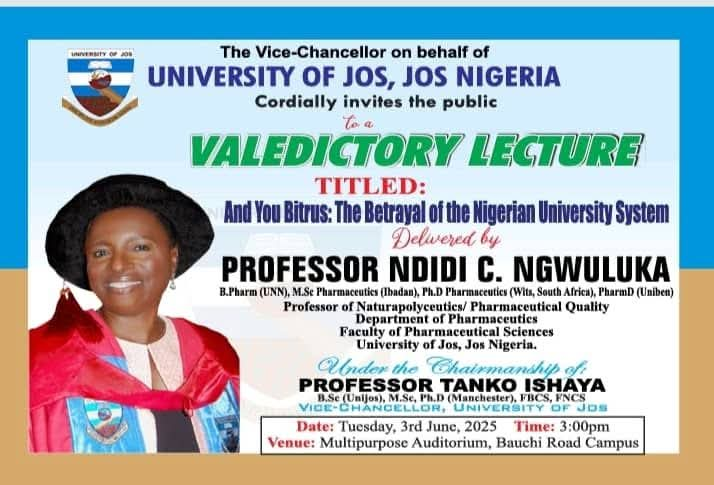
A professor at the University of Jos has described Nigeria’s university system as one in a state of systemic collapse, weakened by corruption, political interference, and the abandonment of merit.
Professor Ndidi Ngwuluka, who delivered her valedictory lecture titled “And You, Bitrus: The Betrayal of the Nigerian University System,”said the sector is being crippled by entrenched dysfunctions that are no longer hidden.
Ngwuluka, who served as Professor of Naturalpolyceutics/Pharmaceutical Quality in the Department of Pharmaceutics, Faculty of Pharmaceutical Sciences, explained that “Bitrus” in her lecture title represents the multiple forces sabotaging university education in Nigeria.
She blamed political meddling, poor funding, and the erosion of institutional values for the steady decline.
“The Nigerian university has become a place where corruption is rampant and merit is sacrificed on the altar of favoritism, bureaucracy, and inefficiency,” she said.
“This political interference results in leadership that lacks vision or the capacity to drive meaningful change. The focus shifts, and universities become underfunded, creating an environment where the quality of education becomes secondary to political and administrative interests.”
Ngwuluka also condemned the politicization of academic appointments, saying key roles are now awarded based on political loyalty rather than competence.
According to her, government interference in staff recruitment and administration has undermined the autonomy that universities need to thrive.
She called for urgent reforms to restore integrity in the system, beginning with a collective acknowledgment of the decay.
She advocated for academic freedom, merit-based appointments, improved infrastructure, and stronger investment in research.
“There must be a deliberate effort to foster a culture of critical inquiry and innovation across all levels,” she added.
Representing the Vice-Chancellor at the event, Professor Joash Amaputan echoed similar concerns, noting the growing disconnect between universities, research, industry, and local communities.
“The title serves as a poignant reminder that our individual and collective actions shape the trajectory of our institutions. It calls us to recommit to the values of integrity, accountability, and excellence in education,” Amaputan said.