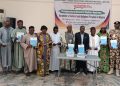
Speaking at a press briefing, the Secretary-General of the association, Suleiman A.D. Sukukum, alongside the group’s President, Danladi Jeji, said the country is facing a disturbing expansion of violent attacks and killings across multiple regions.
According to CONAECDA, recent incidents recorded in Niger, Kwara, and Kogi States point to what it termed a “new wave” of insecurity. The association also noted that several states, including Plateau, Benue, Nasarawa, Taraba, Borno, and Kaduna, continue to experience repeated assaults from armed groups and suspected terrorists.
The group further expressed concern over reports of armed elements allegedly taking advantage of forests and remote settlements, including areas around the Federal Capital Territory, warning that such locations are increasingly being used as safe havens and operational bases.
CONAECDA cautioned against framing insecurity along ethnic or religious lines, stressing that violent groups often exploit social, political, and economic divisions to recruit and operate. It referenced recent unrest in Angwan Rukuba, Jos, noting that competing narratives around such incidents have continued to deepen mistrust among communities.
The association maintained that, regardless of the circumstances, the protection of human life must remain paramount. Sukukum reiterated that all lives hold equal value and must be safeguarded.
It also urged that ongoing debates over indigene-settler relations in Plateau and other parts of the Middle Belt should not be politicised. While acknowledging that all Nigerians have constitutional rights to political participation, the group insisted that indigenous communities also have long-established traditional and cultural ties that must be respected.
On the issue of rural banditry and terrorism, CONAECDA extended condolences to affected families and communities while commending the efforts of the armed forces and other security agencies. It, however, called on the Federal Government to scale up rehabilitation programmes for victims, rebuild destroyed communities, and ensure the safe return of displaced persons.
The association also urged the administration of President Bola Tinubu to openly confront what it described as terrorist groups allegedly driven by extremist religious ideologies operating in parts of the country.
In a symbolic move, CONAECDA announced the designation of the last Thursday of every month as “Black Thursday,” intended to honour victims of violence nationwide and draw attention to the sanctity of human life across all ethnic and religious groups.
The group also raised concerns over reports of hills, sacred groves, and cultural heritage sites being converted into grazing areas in parts of the Middle Belt, describing the development as a serious threat to cultural preservation. It called for urgent intervention from local communities, environmental agencies, and international partners.
On religious freedom, the association condemned alleged cases of forced conversion, abductions, and underage forced marriages affecting both Christian and Muslim minors. It renewed its call for the creation of a Religious Rights Commission to strengthen protections for religious liberty and vulnerable populations.
Looking ahead to the 2027 polls, CONAECDA warned against anti-democratic practices by political actors and urged the Independent National Electoral Commission (Independent National Electoral Commission) to ensure credible, transparent, and peaceful elections, while calling on politicians to strictly adhere to democratic principles.